



 USA
USA Italy
Italy France
 UK
UK Germany
 Japan
Japan
If you sell vape products in the U.S., you have probably seen the term PMTA everywhere. It shows up in FDA announcements, supplier emails, product listings, and conversations about which vape products can stay on the market.
But PMTA is more than a three-letter acronym.
For manufacturers, it is a major premarket regulatory pathway. For distributors and vape retailers, it is closely connected to a much simpler question: Can this product legally be marketed and sold in the U.S.?
That question has become even more important after the FDA announced on September 28, 2026 that it intends to evaluate changes to the current PMTA regulatory framework. The agency said it is considering whether a new rulemaking could eventually replace the current framework, while also making clear that it will continue reviewing PMTA submissions and making regulatory decisions under the existing requirements for now.
So, what exactly is PMTA? Why is the FDA reconsidering the framework? And what should U.S. vape retailers and distributors actually pay attention to?
Why Is the FDA Reconsidering the PMTA Framework?
FDA Signals a Possible New Direction for PMTA in 2026
The FDA’s latest announcement does not mean that PMTA has been cancelled or that a new system is already in effect.
Instead, the agency says it intends to evaluate changes to the PMTA regulatory framework, potentially through new rulemaking. The FDA pointed to several factors behind that decision, including its experience implementing the 2021 PMTA rule, the growth of an illicit and unregulated market, the rapid pace of new tobacco product introductions, and the need for greater clarity and predictability.
That distinction matters.
For businesses selling vape and e-cigarette products today, the existing framework still matters. The FDA says it will continue to process PMTA submissions, conduct premarket reviews, and issue regulatory decisions under the current statutory requirements while it considers what changes may be appropriate.
In other words, this is a potential reset of the framework, not an immediate reset of the rules.
For retailers, that means the safest approach is not to assume that today’s requirements no longer matter. If anything, keeping track of the product’s current regulatory status becomes more important while the policy discussion develops.

Why Does the Current Vape Market Put Pressure on PMTA?
Part of the issue is simply how quickly the vape market changes.
New disposable vapes, pod systems, nicotine products, flavors, hardware configurations, and other products can enter the market at a much faster pace than a traditional regulatory system was designed to handle.
The FDA has also acknowledged the development of a large illicit and unregulated market. That creates a difficult situation for regulators, manufacturers, distributors, and retailers alike.
A regulatory framework needs to do more than exist on paper. It needs to provide a workable way to evaluate products, distinguish authorized products from unauthorized ones, and give businesses enough clarity to understand what they can actually market.
That is one reason the FDA says a modernized framework with greater clarity and predictability is important for protecting public health.
But until any future rulemaking actually takes effect, the current PMTA framework remains the reference point.
What Is PMTA and How Does It Work?
What Does PMTA Mean?
PMTA stands for Premarket Tobacco Product Application.
The easiest way to understand the name is to break it into three parts.
Premarket means the regulatory review takes place before a new tobacco product can be lawfully marketed under the applicable premarket authorization requirements.
Tobacco Product refers to products that fall under the FDA’s tobacco-product authority. This includes electronic nicotine products such as many e-cigarettes and vape products.
And Application means that a company or other eligible applicant submits information to the FDA asking for authorization to market a particular new tobacco product.
So PMTA is not simply a registration database. It is a premarket review pathway.
The basic idea is straightforward: before a new tobacco product enters the U.S. market under this pathway, the applicant must provide FDA with scientific and other information that allows the agency to determine whether marketing that product is appropriate for the protection of public health.
This is where PMTA becomes much more complicated than a simple “safe or unsafe” test.
The FDA does not evaluate a new tobacco product only by asking whether an individual product contains a particular ingredient or whether the device works correctly. Under the statutory standard, the agency considers the risks and benefits to the population as a whole.
That means the question is broader.
How might the product affect people who already use tobacco? What could happen if existing tobacco users switch to the new product or reduce their use of other tobacco products? At the same time, could the product encourage people who do not currently use tobacco to start?
PMTA is therefore designed as a population-level regulatory review, rather than simply a product-quality certificate.
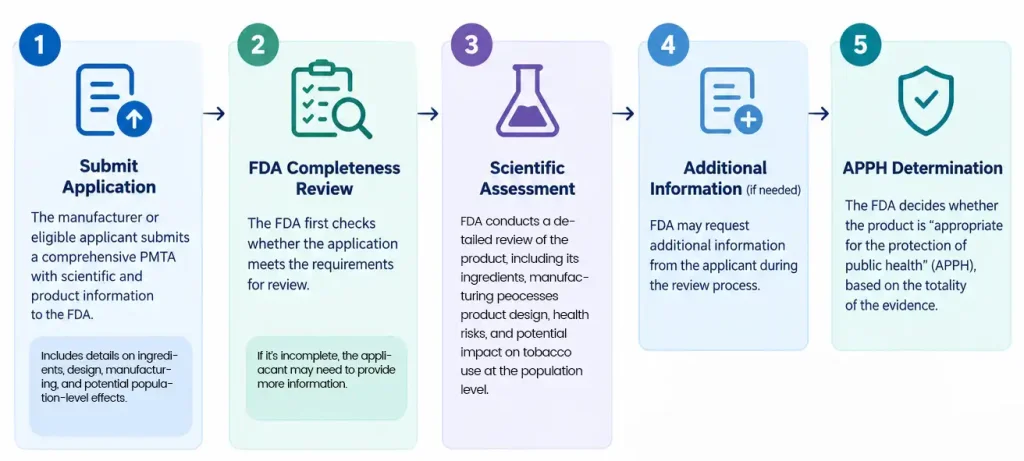
The PMTA process starts when a manufacturer or other eligible applicant submits a detailed application for a new tobacco product to the FDA. FDA first checks whether the application meets the requirements for review, then conducts a substantive scientific assessment of the product, including its ingredients, manufacturing processes, product design, health risks, and potential impact on tobacco use at the population level. During the review, FDA may request additional information before determining whether the product meets the Appropriate for the Protection of Public Health (APPH) standard. The process ultimately ends with a Marketing Granted Order or a Marketing Denial Order. In simple terms: submit → FDA review → additional information if needed → APPH determination → marketing order or denial.
What Does the FDA Look at in a PMTA?
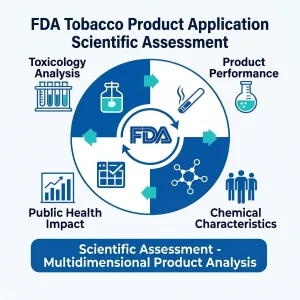
A PMTA can contain a substantial amount of information. The FDA’s requirements cover the product itself, the science behind it, manufacturing information, and information relevant to how the product could affect the U.S. population.
The agency’s current PMTA guidance identifies several important areas.
First, FDA considers the risks and benefits of the product to the population as a whole, including both people who would use the proposed product and people who would not.
Second, the agency considers whether people who already use tobacco products would be more or less likely to stop using tobacco products, or otherwise change their tobacco use, if the proposed product were available.
Third, FDA considers whether people who currently do not use tobacco products would be more or less likely to begin using tobacco products if the new product became available.
And that is only part of the picture.
The application also includes information about how the product is manufactured, processed, and packaged. The methods, facilities, and controls involved in production can all become relevant to the review.
The applicant is therefore not simply saying, “Here is our vape. Please approve it.”
The applicant is building a regulatory record that allows FDA to evaluate the product under the Appropriate for the Protection of Public Health, or APPH, standard.
That is the central idea behind the PMTA system.
FDA’s current PMTA process also has several stages. A submission can go through an acceptance review, followed by a filing review, and then a more substantive scientific review. FDA may request additional information during the review. Eventually, the agency can issue a Marketing Granted Order or a Marketing Denial Order.
This is important because “submitted,” “accepted,” “under review,” and “authorized” are not interchangeable terms.
PMTA Is Not a Blanket Approval for a Brand
One of the easiest mistakes for retailers to make is thinking about PMTA at the brand level.
For example, a brand may have multiple disposable devices, pod systems, nicotine strengths, flavors, or product versions. The fact that one product has received a marketing authorization does not automatically mean every product sold under the same brand has the same status.
The FDA’s own submission guidance reflects this product-specific approach. Even when products are submitted together as a grouped submission, the individual products still need to be identified and supported appropriately.
For a retailer, the practical takeaway is simple: check the specific product, not just the brand name.
Pending PMTA Does Not Automatically Mean “Approved”
This is another point worth remembering.
A company submitting a PMTA does not automatically receive marketing authorization simply because an application exists.
Likewise, “pending,” “submitted,” or “under review” should not casually be translated into “FDA approved.”
The FDA maintains information about tobacco products and its regulatory decisions, and its current enforcement materials make clear that a pending application does not itself create a general safe harbor for selling a product that requires authorization.
There can be specific enforcement policies or circumstances that affect how FDA prioritizes enforcement. But that is different from receiving a marketing authorization.
For retailers, keeping those concepts separate can prevent a lot of confusion.
Why Does PMTA Matter to Vape Retailers and Distributors?
How PMTA Affects Your Vape Inventory
If you are a manufacturer, PMTA may be an application and scientific review process.
If you are a retailer, it becomes an inventory question.
You may not be the company submitting the PMTA. In many cases, your supplier or manufacturer handles the regulatory application. But that does not mean the regulatory status of the product is irrelevant to your business.
If a product requires FDA premarket authorization and does not have the necessary authorization, selling it can create regulatory risk for the retailer.
This is why “my supplier sells it” is not always enough.
A distributor can provide a product. A manufacturer can claim that a product is compliant. A product can also have a PMTA submission number or appear in a conversation about pending applications.
None of those facts, by themselves, should be treated as the same thing as FDA marketing authorization.
For a U.S. vape shop, the more useful mindset is to treat regulatory status as part of product due diligence.
Before adding a new vape or e-cigarette product to inventory, ask what product it is, who makes it, what regulatory pathway applies, and what FDA action or authorization supports its marketing.
What Should U.S. Vape Retailers Check Before Selling an E-Cigarette?
There is no single piece of paperwork that can replace due diligence.
Instead, retailers can build a simple verification habit around every new product they plan to stock.
Verify the Product, Not Just the Brand
Start with the exact product name and version.
Check the manufacturer or applicant. Check the product category. Check whether the FDA has published a relevant marketing order or other regulatory action.
The FDA’s searchable tobacco product database can be particularly useful here because it is designed to provide information about tobacco products that may be legally marketed and includes information such as product name, company, product category, and FDA action.
This is much more useful than relying only on a supplier’s product catalog.
Keep Supplier and Product Records
Retailers and distributors should also keep reasonable records showing where products came from and what information was provided about their regulatory status.
That might include supplier information, invoices, product names and SKUs, manufacturer details, regulatory documentation, and relevant FDA records.
Think of it as basic inventory due diligence.
The U.S. vape market can change quickly. A product that was widely available yesterday can become the subject of regulatory attention tomorrow. Having clear records makes it easier to understand what is in your inventory and where it came from.
And this is exactly why the current PMTA discussion matters even if you never submit a PMTA yourself.
The FDA may eventually change the framework. The agency has not done so yet. For now, retailers and distributors still need to operate within the existing regulatory environment while watching for future rulemaking and official guidance.
For anyone working in the U.S. vape industry, PMTA is worth understanding not because every retailer needs to become a regulatory lawyer, but because the status of a product can directly affect whether that product belongs on your shelf.
The simplest way to think about PMTA is this: it is the FDA’s premarket pathway for evaluating certain new tobacco products before they can be lawfully marketed under the applicable authorization requirements.
And for retailers, that turns into an even simpler rule: know exactly what you are selling, who made it, what regulatory pathway applies, and what FDA action supports its legal marketing.
FAQ
Q1 Is PMTA required for every vape product?
Not every vape product should be described simply as “requiring PMTA.” The requirement depends on whether the product is a new tobacco product subject to FDA premarket authorization and which statutory pathway applies. PMTA is one of the FDA’s premarket pathways.
Q2 Does a pending PMTA mean a vape product is FDA approved?
The 55/3/30 regime uses a 55 mL puff volume, 3-second puff duration, and a 30-second interval between puffs. It is associated with CORESTA Recommended Method No. 81 and ISO 20768 for controlled analytical vaping-machine testing.
Q3 Why can two 50K disposable vapes last different amounts of time?
No. A pending PMTA means an application has been submitted and is being processed or reviewed. It does not by itself mean FDA has issued a marketing authorization.
Q4 Does a PMTA belong to the brand or the product?
PMTA review is product-specific. A brand may have multiple products, versions, flavors, or configurations, and one product’s regulatory status should not automatically be applied to every product sold under the same brand.
Q5 Do vape retailers need to submit PMTAs?
PMTA applications are generally submitted by manufacturers or other eligible applicants seeking FDA authorization. Retailers usually do not submit PMTAs for the products they sell, but they still need to pay attention to whether the products they stock can legally be marketed.
Q6 Is the FDA changing the PMTA rules right now?
Not yet. In September 2026, FDA announced that it intends to evaluate changes to the PMTA regulatory framework and could potentially begin new rulemaking. The agency also said that, in the meantime, it will continue processing PMTA submissions and making regulatory decisions under the current requirements.
Q6 Where can retailers check FDA tobacco product information?
Retailers can use FDA’s searchable tobacco product database and the agency’s published marketing order information to research specific products and companies. It is better to verify the exact product rather than rely only on a brand name or supplier statement.