USA
USA Italy
Italy France
 UK
UK Germany
 Japan
Japan
A better approach is to examine the entire product as a system. Start with the packaging before opening it. Look at the printing, paperboard, coatings, seals, tear strips, security labels, and small finishing details. Once the box is open, examine the device itself, including its surface finish, molding quality, seams, logos, pod connection, and included accessories. Finally, compare what you have with the manufacturer’s official product information and authentication system.
This guide explains how to identify the warning signs of a counterfeit vape without relying on a single “magic test.” It also looks at official authentication systems used by major vape brands and regulatory requirements in several major vaping markets, including the United States, European Union, United Kingdom, Canada, Australia, and New Zealand.
Start With the Packaging: What Can You See Before Opening the Box?
The packaging is often the first place where inconsistencies appear. Counterfeiters can reproduce a brand’s artwork and basic layout, but reproducing every production detail is much more difficult. Commercial packaging involves specific paper or board substrates, printing processes, coatings, adhesives, die-cutting, folding, perforation, and finishing operations. Small differences can therefore become visible when you know what to look for.
Check the Box Material and Paperboard Quality
Do not look only at the artwork. Pay attention to the physical material of the box.
Most folding cartons are produced from some form of paperboard or coated board stock. The exact substrate varies by manufacturer and product, but genuine packaging normally has a consistent relationship between its thickness, stiffness, surface texture, and printed finish. A counterfeit package may use a cheaper or different substrate even when the artwork looks almost identical.
One useful technical term is GSM, meaning grams per square metre. GSM is commonly used to describe the basis weight of paper and paperboard. A higher GSM does not automatically mean better or more authentic packaging, but a noticeable difference in stiffness or board weight can be useful when comparing a suspected product with a known genuine package of the same model.
Pay attention to how the carton behaves when handled. Does it feel rigid or unusually flexible? Does the surface feel smooth, slightly textured, coated, or unusually rough? Does the box spring back naturally after being pressed, or does the board remain visibly creased?
These differences should not be treated as proof by themselves. Packaging materials can change between production runs, regions, or generations of a product. The useful question is whether the physical construction is consistent with the official packaging you are comparing it against.
Look at the Printing: Registration, Ink Density, and Fine Details
Printing quality can reveal details that are difficult to notice in a quick visual inspection.
Look closely at small text, fine lines, logos, icons, barcodes, and warning information. Genuine commercial printing normally has controlled registration between different printing elements. Print registration refers to the alignment of different colour layers or printing plates. When registration is poor, edges can appear slightly shifted, coloured outlines may become visible around letters, or fine graphics may look less precise.
You can also examine the apparent ink density and halftone structure. Photographic images and gradients are often reproduced using halftone dots or other screened printing processes. On a genuine package, these patterns are normally consistent with the manufacturer’s printing method. A low-quality reproduction may show coarse dots, muddy shadows, excessive contrast, or colour areas that appear uneven.
Small text is particularly useful. Look for inconsistent letter spacing, missing punctuation, strange character shapes, uneven baseline alignment, spelling errors, or differences in font weight. Counterfeit packaging may reproduce the overall design correctly while failing to reproduce the fine typography.
The comparison becomes stronger if you can place the suspected package beside an official product image or, even better, a known genuine package from the same product generation.
Examine Coatings and Surface Finish
The printed surface of a package may have a coating that changes how it feels and reflects light. Common packaging finishes include aqueous coating, varnish, matte coating, gloss coating, UV varnish, spot UV, and various film laminations.
A counterfeit package may use a different finish from the genuine product. For example, a surface that should have a soft matte appearance may instead look noticeably glossy. A graphic that should have a subtle spot-UV effect may appear completely flat. Conversely, an imitation may use a cheap glossy film that produces excessive glare.
Run your fingers lightly over areas that are supposed to have different finishes. Do not press hard or attempt to damage the package. You are looking for changes in surface friction, gloss, texture, and the transition between coated and uncoated areas.
Some premium packaging also uses tactile varnish, embossing, or debossing. Embossing raises a design element above the surrounding surface, while debossing presses it into the material. If the official package uses one of these effects, an imitation may reproduce the graphic visually without reproducing the actual physical relief.
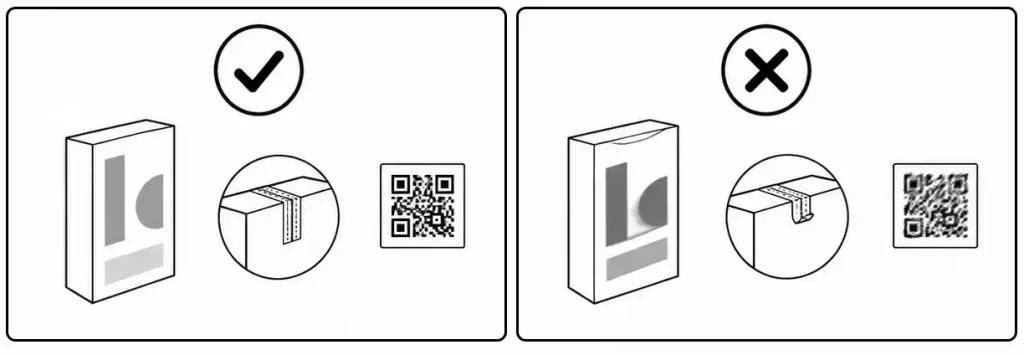
Check the Seal, Shrink Wrap, and Tear Strip
The opening mechanism deserves special attention because it is difficult to reproduce consistently after a package has already been opened.
Look for the primary seal, shrink band, adhesive closure, perforated strip, or other tamper-evident feature used on the package. A genuine tamper-evident system is designed so that opening the package leaves some visible indication of interference.
A seal that is obviously broken, lifted, re-glued, cut, or replaced should therefore be treated as a warning sign. It does not automatically prove that the product is counterfeit because legitimate products can sometimes be opened during inspection, damaged during transportation, or repackaged under legitimate circumstances. However, it deserves further investigation.

Does the Tear Strip Open Cleanly?
The tear strip is a small detail that is easy to overlook.
When a carton uses a perforated tear strip, examine how the perforation is cut and how the strip separates from the surrounding board. A genuine package may open with a relatively controlled tear because the perforation pattern, board stock, adhesive placement, and die-cutting process were designed together.
A suspicious package may show irregular tearing, excessive paper fibre pull-out, jagged perforations, incomplete cuts, or a strip that separates from the wrong layer of the carton.

The “smoothness” of the tear can therefore be useful as an observation, but it should never be treated as a standalone authenticity test. Different packaging materials can produce different tearing behaviour, and even genuine products can vary slightly between manufacturing batches.
Look at What the Seal Leaves Behind
After opening a package, examine the area around the seal rather than only the seal itself.
Look for adhesive residue, lifted paper fibres, delamination, uneven adhesive transfer, cut edges, or evidence that a label or strip has been removed and replaced. Delamination means that layers of a laminated or bonded material have separated from each other. If the packaging construction normally uses laminated layers, unexpected separation can be significant.
Also look for adhesive patterns that appear inconsistent with the surrounding packaging. A resealed package may have glue residue in places where the original package would not normally show it.
Inspect the QR Code, Barcode, Security Label, and Serial Information
A QR code is useful, but the existence of a QR code does not prove authenticity. A counterfeit package can simply print a QR code that looks correct.
Look at the physical printing first. Is the QR code sharply defined? Are the modules clean and square? Does the surrounding quiet zone appear intact? Is the code positioned exactly where the manufacturer’s official packaging shows it should be?
Then check where the code leads. A QR code that redirects to an unrelated domain, an unofficial verification page, a suspicious website, or a page with an unusual spelling of the brand name should be treated with caution.
Do not assume that scanning a code is automatically safer than typing the official website address manually. Some manufacturers specifically warn consumers to use their official domain for verification rather than trusting an unfamiliar QR destination.
Compare the Packaging Against Official Product Images
One of the simplest methods is also one of the most effective: compare the package with official images from the manufacturer.
Check the position of logos, warning panels, product names, colour blocks, icons, security labels, barcodes, regulatory information, and package dimensions. Look for differences in the number of labels, the location of the scratch-off area, or the exact arrangement of printed information.
Do not rely on random marketplace photographs if an official product page, manual, verification page, or regulatory filing is available. Product packaging can change over time, so the most useful comparison is with material corresponding to the same model and product generation.
Inspect the Vape Device: Materials, Manufacturing, and Surface Quality
Once the package has been opened, the physical device provides another group of clues. This is where material quality and manufacturing details become especially useful.
A counterfeit device may copy the general silhouette of an authentic model while using different materials, different tooling, or less controlled finishing processes. The goal is not to decide whether a device “feels expensive.” The goal is to identify physical inconsistencies that can be compared against an official product or known genuine sample.
Identify the Main Material and Surface Treatment
Vape devices can contain several different materials, including aluminum alloys, zinc alloys, stainless steel, plastics, and transparent polymers used for pods or tanks. The external finish can also vary considerably.
A metal surface may be anodized, painted, powder coated, plated, brushed, sandblasted, polished, or treated using other finishing processes. Some products use PVD-type decorative coatings or other thin-film surface treatments.
You do not need laboratory equipment to notice obvious differences. Compare the colour, gloss level, texture, edge treatment, and consistency of the finish with official photographs or a genuine unit.
For example, a genuine device with a uniform brushed finish should normally show a consistent directional texture. If the suspected device has a random or uneven texture, the difference may be worth investigating. Similarly, a matte coating that appears unusually glossy or a metallic finish that looks more like painted plastic can be a useful warning sign.
Inspect Injection-Molded Plastic Parts
Plastic pods, mouthpieces, buttons, covers, and internal housings are often produced using injection molding. The molding process can leave characteristic manufacturing features.
Look for the parting line, which is the line where two halves of a mold meet. On a well-produced component, the parting line is generally controlled and consistent. Excess material along this line is commonly called flash.

Flash, rough edges, uneven wall thickness, visible sink marks, inconsistent surface texture, or poorly finished gate marks can be useful warning signs when they are significantly different from an authentic component.
A gate mark is associated with the point where molten plastic enters the mold. It can appear in different forms depending on the tooling and design. Again, the presence of a gate mark is not inherently suspicious. What matters is whether its position, shape, and finish are consistent with the genuine component.
Check Seams, Edges, Buttons, and Assembly
Run your eyes along the device rather than looking only at the logo.
Check whether seams line up evenly. Look at the junction between metal and plastic parts, the fit of buttons, the mouthpiece connection, charging-port alignment, and the transition between different panels.
A poorly manufactured counterfeit may show uneven gaps, excessive movement, sharp unfinished edges, inconsistent panel alignment, or visible adhesive. These issues can be particularly noticeable around removable panels, pod bays, mouthpieces, and charging ports.
Look for unexpected rattling or movement as well. A button or panel that feels significantly looser than the official product may indicate a different component or lower manufacturing tolerance.
Inspect the Pod, Tank, and Liquid Contact Areas
If the product uses a removable pod or cartridge, inspect the connection area carefully.
Look at the pod shell, mouthpiece, magnets, electrical contacts, seals, and connection geometry. The pod should sit correctly in the device without excessive movement. Contact surfaces should be clean and positioned consistently with the design of the device.
Unexpected e-liquid residue, corrosion, contamination, damaged seals, or poor alignment can indicate a quality problem. These observations are not necessarily proof of counterfeiting, but they are reasons to stop and investigate before using the product.
Pay Attention to Smell and Material Feel
Material feel can sometimes provide useful information, but it needs to be interpreted carefully.
New plastics, adhesives, coatings, and packaging materials can have characteristic odours. A strong chemical smell that is very different from a known genuine product may be worth investigating, particularly when combined with other inconsistencies.
The same applies to tactile feel. Compare surface friction, hardness, weight, texture, and temperature response with a genuine sample where possible. Do not assume that “lighter” automatically means fake or that “heavier” automatically means genuine. Different materials can achieve similar shapes and weights.
The strongest approach is comparative rather than subjective: instead of asking whether the device feels good, ask whether its material and finish are consistent with the manufacturer’s original construction.
Check the Contents: Does Everything Match the Original?
Counterfeiters do not always reproduce every component in the original package. Sometimes the device looks convincing while the accessories, pod, manual, cable, coil, or other contents reveal differences.
Compare the Complete Package With the Official Product
Find the manufacturer’s official product page, user manual, unboxing information, or product documentation and compare the contents of the box.
Check the exact number and type of accessories. Does the package contain the correct charging cable? Is the manual the correct version? Does the device come with the expected pod, coil, cartridge, mouthpiece, spare seals, or other components?
Pay attention to packaging inserts as well. Genuine products may use molded pulp, cardboard trays, PET, or other internal packaging structures designed specifically for the device. A counterfeit may use a simpler insert that holds the device in place but does not match the official internal layout.
Inspect the Pod and Coil Construction
Pods and coils contain several small components, so they can provide additional comparison points.
Look at the transparency and moulding of the pod, the shape of the mouthpiece, the location of fill ports, seals, magnets, contact pins, and other structural details. Compare these elements with official photographs or documentation.
For replaceable coils, examine the printed resistance value, branding, airflow openings, metal finish, insulator, and overall geometry. A counterfeit component may copy the general appearance while using different printing, different machining, or different materials.
Do not assume that every visual difference means a fake. Manufacturers sometimes revise components without completely redesigning the product. This is why the model number, production generation, and official documentation matter.
Check Charging Cables and Other Accessories
Accessories are often overlooked because consumers focus on the main device.
Inspect cable connectors, printing, moulding, connector housings, and included documentation. Look for obvious differences from the official product photographs or manual.
A charging cable that appears substantially different from the one documented by the manufacturer may indicate that the package has been altered or that the product is not the same configuration as the official version.
Look for Signs of Repackaging
Sometimes the question is not simply “Is this device fake?” The product may be genuine but the package may have been opened, replaced, or altered.
Look for mismatched inner trays, damaged labels, different production dates, inconsistent fonts, adhesive residue, replacement stickers, or accessories that appear to come from another product.
A package containing a genuine device but suspicious or altered packaging should still be treated cautiously because the condition of the product and the integrity of the supply chain are separate questions.
Verify the Product: Authentication Codes, Regulations, and the Bigger Picture
Physical inspection is useful, but modern vape authentication systems provide another layer of evidence. Several major manufacturers operate dedicated verification systems, and their methods show why a combination of physical and digital checks is more useful than relying on one feature.
Look at How Major Vape Brands Authenticate Products
Different manufacturers use different anti-counterfeiting systems. These systems can also change over time, so always follow the instructions for the specific product generation.
- Innokin Product Verification uses unique security or authentication codes associated with product packaging. Its official instructions also warn users to be cautious when the same code has been checked multiple times.
- GEEK Verification explains that its official product verification system uses QR codes and verification numbers located on the product packaging.
- VAPORESSO Product Authentication provides instructions for checking its anti-counterfeiting labels and verification system. The manufacturer describes different generations of security labels and visual features.
- VOOPOO Security Code provides instructions for its security-code system. Depending on the label version, users may be instructed to inspect a visual effect under changing viewing angles, scratch the silver covering, scan the QR code, and enter the security code.
- Aspire Product Verification V4 explains changes to its anti-counterfeit label, including holographic elements, a scratch-off area, and QR-code-based verification.
These systems are useful examples because they demonstrate that authentication is not always just “scan a QR code.” Security features can include unique codes, scratch-off panels, holographic effects, changing optical elements, QR verification, and official verification databases.
Compare the Product With Regulatory Requirements in Your Market
Authenticity is not only a brand issue. Legal vaping products in different markets must also meet local requirements for packaging, labelling, safety, notification, and traceability.
In the European Union, Article 20 of the Tobacco Products Directive establishes requirements for electronic cigarettes sold as consumer products. The European Commission notes requirements concerning child-resistant and tamper-evident construction, packaging information, nicotine content, ingredients, and leaflets.
In Great Britain, the Medicines and Healthcare products Regulatory Agency provides guidance covering the safety, quality, notification, packaging, and labelling of nicotine-containing vaping products. The UK framework also requires nicotine-containing products or their packaging to be child-resistant and tamper evident.
Canada provides another useful comparison. Health Canada states that legal vaping products must meet requirements under Canadian consumer-product and tobacco/vaping legislation, including packaging and labelling rules. Its consumer guidance notes features such as child-resistant packaging, bilingual labelling, nicotine information, health warnings, and an excise stamp over the seal.
Australia‘s Therapeutic Goods Administration has specifically warned consumers about counterfeit nicotine vaping products and has explained that counterfeit products can involve undeclared nicotine or altered presentation. The TGA also publishes guidance concerning the quality and labelling requirements for therapeutic vaping products.
New Zealand‘s Ministry of Health provides detailed packaging and labelling requirements for vaping products, including manufacturer or importer information, batch numbers, expiry information, nicotine concentration, safety instructions, and required warning messages. These requirements can provide useful reference points when checking whether packaging appears consistent with a particular market.
In the United States, the FDA has also identified counterfeit and otherwise unauthorized tobacco products, including electronic nicotine delivery systems, as an enforcement concern. Its regulatory materials provide another reason to pay attention to product origin, packaging, labelling, and supply-chain information.
These requirements should not be used as a universal checklist for every country. A product legally packaged for one market may look different from a product legally packaged for another market. The correct comparison is always between the product, its intended market, and the relevant local requirements.
Use a Multi-Signal Approach
Authenticity is rarely determined by one detail. It is determined by the consistency of the entire product — from the seal you tear, to the printing you read, to the materials you hold, to the components inside the box, and finally to the verification system you check.
For example, imagine a package with slightly unusual printing but a valid manufacturer verification code. That deserves a different interpretation from a package with unusual printing, a damaged seal, an inconsistent device finish, and a security code that produces an unexpected result.
Likewise, a broken seal alone does not automatically prove that a vape is counterfeit. A QR code that works does not automatically prove that every component inside the box is genuine. A device that feels heavier does not automatically prove authenticity.
The strongest evidence comes from multiple independent observations pointing in the same direction.
What to Do If You Suspect a Counterfeit Vape
If several warning signs appear at the same time, avoid relying on the product simply because one part of the package looks convincing.
Take clear photographs of the packaging, security label, serial number, device, pod, and any unusual manufacturing details. Keep the receipt, order confirmation, seller information, and other purchase records.
Then contact the manufacturer through its official website or support channel. Provide the product identification information and explain the inconsistencies you found.
If you purchased the product through a retailer or online marketplace, contact the seller as well. A legitimate retailer should be able to provide information about its supply chain and the origin of the product.
Do not attempt to “fix” suspicious packaging by replacing labels, removing seals, or transferring the contents into another package. Once the original packaging has been altered, it becomes harder to establish what happened to the product.
Before You Use It
Checklist: Does Your Vape Look Authentic?
Conclusion: Look for Consistency, Not a Single Perfect Test
The most reliable way to spot a counterfeit vape is to slow down and examine the product as a complete object.
Start with the packaging. Look at the board stock, printing, typography, coatings, security labels, tear strips, perforations, adhesives, and tamper-evident features. Then move to the device itself and examine the materials, molding, seams, surface treatment, logos, connectors, pod, and other components.
Finally, verify the product through the manufacturer’s official authentication system and compare its packaging and labelling with the requirements of the market where the product is supposed to be sold.
No single clue is perfect. A smooth tear does not prove authenticity. A hologram does not prove authenticity. A QR code does not prove authenticity. Even a successful verification result should be considered together with the physical product and its packaging.
What matters is consistency. When the package, printing, materials, manufacturing details, components, product information, security features, and official verification result all point to the same product, you have a much stronger basis for judging authenticity than you would from any single detail alone.