



 USA
USA Italy
Italy France
 UK
UK Germany
 Japan
Japan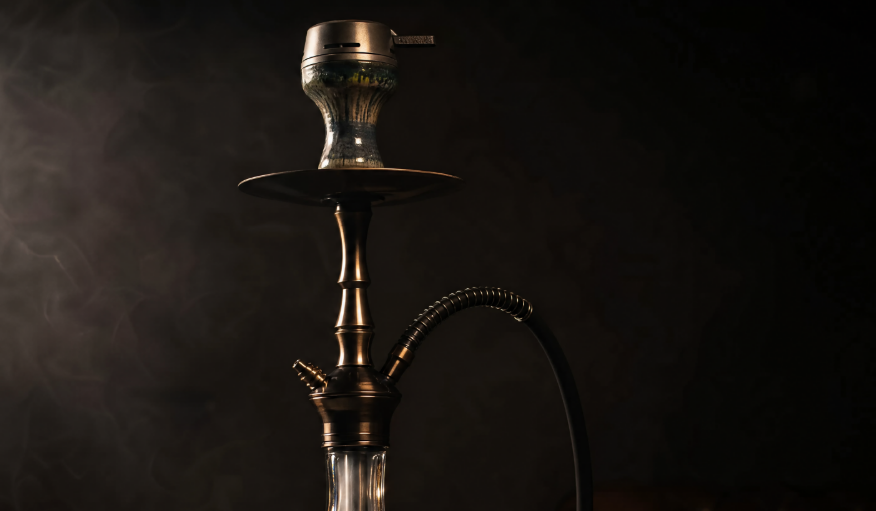
When people talk about modernizing hookah, the conversation often starts with technology.
Better heating. Digital controls. Batteries. Temperature adjustment. Automatic heat management.
All of these developments can make a shisha session more convenient. But there is another question that deserves more attention:
Does modernizing hookah really mean turning the entire hookah into another piece of home electronics?
For many hookah enthusiasts, the answer may not be so simple.
A hookah is not only a device for producing smoke. It is also a visual object, a social object and, for some users, even a handmade object. The glass base, the stem, the bowl, the hose and even the way smoke moves through the water can all be part of the experience.
This is where an E-HMD (Electronic Heat Management Device for hookah) becomes interesting. Instead of replacing the entire hookah with an electronic appliance, an E-HMD can focus on modernizing one specific part of the experience: heat management.
What is E-HMD and how does it work?
Hover to see what it is.
An electric HMD is an electronic heat management device for hookah or shisha.
It replaces charcoal heat with a heating element powered by a battery or power supply.
Hookah Is More Than a Heating System
If you look at a traditional hookah from a purely functional perspective, its construction can seem unnecessarily complicated.
There is a bowl on top. A stem connects it to a glass base. Water sits at the bottom. A hose connects to the body. Charcoal provides the heat.
But this functional description leaves out something important: the hookah itself is part of the experience.
Unlike many modern electronic products, hookah is designed to be seen.
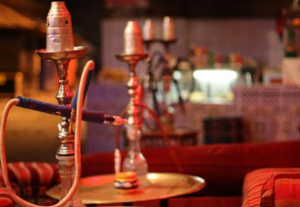
The glass base is usually placed in the center of the table. Smoke can be seen moving through the water. The bowl is visible from above. The hose is handled throughout the session. In a lounge, several hookahs may even become part of the overall interior design.
That visual quality is difficult to measure in specifications, but it is easy to notice when it disappears.
The Bowl Can Be Part of the Craft
For some experienced hookah users, the bowl is not simply a container for shisha.
There are enthusiasts who collect different bowls, experiment with different materials and shapes, and even make or commission handmade bowls. Ceramic bowls, traditional clay bowls and other handcrafted designs can have their own textures, colors, imperfections and proportions.
That creates a relationship between hookah and craftsmanship that is quite different from the world of standardized consumer electronics.
A handmade bowl does not necessarily need to be perfectly identical to another bowl. Its irregularity can actually be part of its appeal.
This is one reason why replacing the entire hookah with a single integrated electronic device can feel like more than a technological upgrade. It can also mean removing some of the personalization that enthusiasts have built into their setups.
The Glass Base Is Part of the Visual Experience
The same principle applies to the glass base.
Some hookah users enjoy watching the water move as they take a draw. Others appreciate the way smoke accumulates inside the base before passing through the water. The shape, transparency and proportions of the glass can completely change the appearance of the setup.
The smoke itself becomes part of the visual experience.
In a lounge, this becomes even more obvious. A hookah may sit on the table for hours, functioning almost like a piece of decorative furniture.
A tall transparent base may fit naturally into a Middle Eastern-inspired interior. A colorful glass piece may work better with neon lighting. A minimal glass setup may suit a contemporary café-style lounge.
The hookah therefore becomes part of the room rather than simply another appliance sitting inside it.
When Modernization Starts Looking Like Another Home Appliance
This is where the design question becomes more complicated.
Modern consumer electronics tend to move toward integration. Batteries become internal. Heating systems become hidden. Displays replace physical controls. Charging ports replace manual preparation. Multiple functions are combined into one body.
From an engineering perspective, this makes a lot of sense.
But when the same philosophy is applied to hookah, something can be lost.
Convenience Versus Character
A fully integrated electronic hookah can be convenient. The battery, heater, controls and airflow system can all be designed as one product.
But the result can also look increasingly similar to a household electronic appliance.
Instead of seeing a glass base, a handmade bowl and a traditional hookah silhouette, the user may see a single industrially designed object with a battery compartment, buttons, display and charging port.
That is not necessarily bad design.
It simply answers a different question.
The goal becomes making hookah behave like an electronic product rather than preserving the visual and physical qualities that make traditional hookah recognizable.
| Approach | What Gets Modernized | What Can Be Preserved |
|---|---|---|
| Traditional Hookah | Little or no electronic heating control | Craft, glassware, bowl, hose and social ritual |
| Fully Integrated Electronic Hookah | Heating, battery, controls and often the entire body | Convenience and electronic control |
| Modular E-HMD | Primarily the heat-management process | The traditional hookah body, appearance and setup |
Why Replace the Heat Instead of Replacing the Hookah?
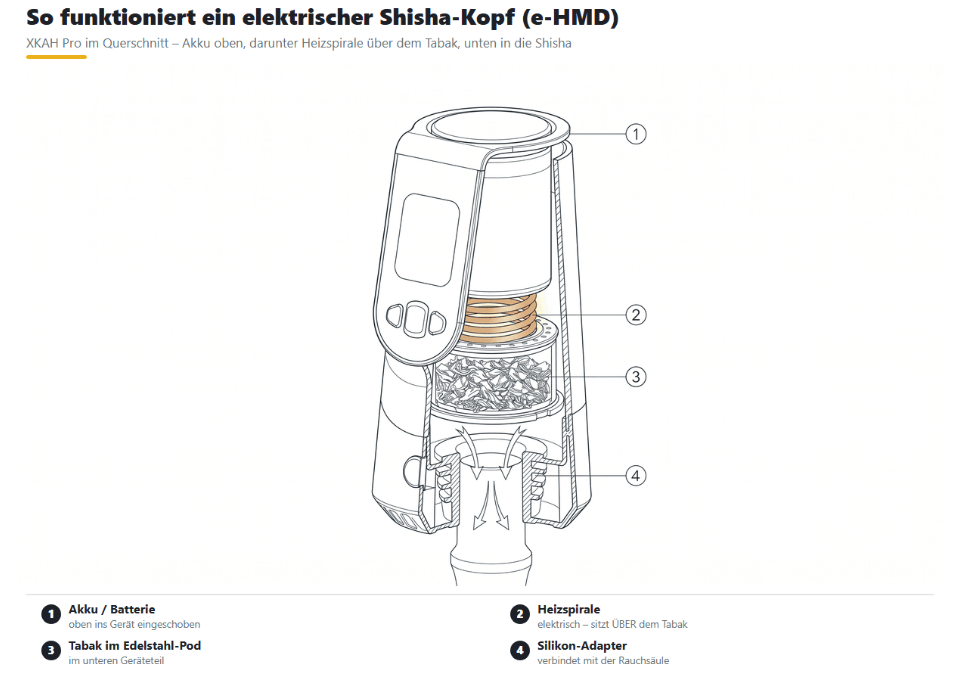
An E-HMD, or Electronic Heat Management Device for hookah, uses an electric heating system to replace the charcoal traditionally used to heat shisha. Instead of placing the tobacco beneath glowing coals, the device generates and regulates heat electronically. Depending on the design, an E-HMD may function as an electric attachment fitted onto a conventional bowl, or it may integrate the bowl, smokebox and heating element into a dedicated pod-based system.
This is the central idea behind an E-HMD. The traditional hookah itself does not necessarily need to be redesigned. The glass base already works. The stem already works. The hose already works. A handmade bowl can still work as part of the setup. The component that creates the most obvious operational inconvenience is often the heat source.
Traditional charcoal needs to be heated, positioned and monitored. Users may need to add or move charcoal during a session. Ash needs to be handled afterward. In a commercial shisha lounge, these tasks are repeated across multiple tables throughout the day. An E-HMD takes a different approach: modernize the heat source while leaving the rest of the hookah recognizable.
Selective Modernization
This can be thought of as selective modernization.
Instead of turning the entire hookah into an electronic system, electronic technology is introduced where it provides the most obvious functional advantage. That distinction is important. It allows the user to keep the parts that carry cultural, visual and social value while changing the part that requires the most manual heat management.
From Charcoal to Vapor: Where Does the Heat Actually Go?
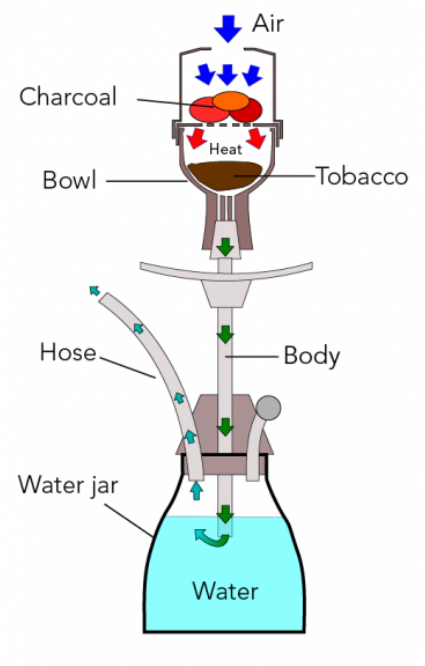
To understand what an E-HMD changes, it helps to follow the journey of a traditional hookah session from the heat source to the user’s mouth.
The process looks simple from the outside, but several different stages happen between lighting the charcoal and seeing smoke come through the water.
Charcoal Creates Heat
In a traditional hookah, burning charcoal acts as the primary heat source. The charcoal itself undergoes combustion while producing the heat needed for the session.
Heat Moves Into the Bowl
Heat from the charcoal passes through the foil or traditional heat-management device and reaches the shisha inside the bowl.
The Shisha Is Heated
As the shisha is heated, its moisture and flavor compounds contribute to the aerosol generated during the session. Temperature influences how the session develops.
Aerosol Is Produced
When the user takes a draw, air passes through the heated shisha. The resulting aerosol is carried away from the bowl and into the stem.
The Aerosol Passes Through Water
The aerosol travels down the hookah stem and bubbles through the water in the glass base. This is one of the most visually recognizable parts of the traditional hookah experience.
The User Takes a Draw
Finally, the aerosol travels through the hose and mouthpiece to the user. What began as heat at the top of the hookah has passed through the entire system before reaching the mouth.
How the Same Process Looks With an E-HMD
Electrical Heating Generates Heat
The E-HMD uses an electrical heating element rather than burning charcoal. Depending on the design, the heating level can be adjusted electronically.
Controlled Heat Reaches the Shisha
The E-HMD transfers heat to the bowl without requiring burning charcoal. Temperature or power settings can be adjusted according to the device and the user’s preferred session.
The Shisha Is Heated
The shisha is still heated inside the bowl. The important difference is that the heat source is electrical rather than a combustion source sitting above the bowl.
Aerosol Is Produced
When the user draws, air moves through the heated shisha and carries the resulting aerosol through the hookah.
The Aerosol Still Passes Through the Water
The traditional glass base can continue to perform its familiar role. The aerosol travels down the stem and bubbles through the water before reaching the hose.
The User Takes a Draw
The final stage remains familiar: the aerosol travels through the hose and mouthpiece to the user.
The Difference Happens at the Top of the Hookah
Notice what has not changed.
The user can still see the glass base. The smoke can still move through the water. A traditional-looking hookah can still sit in the center of a table. A handmade bowl can still be part of the visual identity of the setup when the E-HMD is compatible with it.
The modernization is concentrated around the heat source rather than imposed on the entire hookah.
What the Heat Source Actually Changes
Charcoal does two things at the same time: it provides heat, and it burns.
That distinction matters.
The combustion of charcoal is an additional source of emissions beyond the compounds generated from heating the shisha itself.
Replacing charcoal with electrical heating therefore does not mean that the shisha suddenly becomes emission-free. It means that one important combustion source is removed.
| Heat Source | Main Heat Mechanism | Heat Adjustment | Combustion Source |
|---|---|---|---|
| Charcoal | Burning charcoal transfers heat to the bowl | Move, add or remove charcoal | Yes |
| E-HMD | Electrical heating element provides heat | Electronic temperature or power adjustment, depending on design | No charcoal combustion |
What the Research Says About Charcoal-Free Heating
The argument for electronic heating is not only about convenience.
Researchers have found that charcoal is a major contributor to carbon monoxide and other combustion-related emissions during waterpipe smoking.
A 2019 study comparing electrical heating elements with charcoal reported approximately an 80% reduction in total PAH emissions and a 90% reduction in carbon monoxide emissions under the study conditions. However, the same research also reported higher acrolein emissions with the electrical heating elements tested.
You can review the original research through the published study on PubMed.
More recently, a 2026 study involving 50 waterpipe smokers and 25 non-smokers compared charcoal and electric heating in home settings.
After 15 minutes of smoking, geometric mean exhaled CO levels were reported at 81 ppm with charcoal versus 2.9 ppm with electric heating under the study conditions.
The same study found that electric heating significantly reduced some exposure measures, but it did not significantly reduce urinary biomarkers of nicotine or pyrene. Researchers also observed charred shisha in some electric sessions.
The full study is available through the published research on PMC.
Charcoal-Free Does Not Mean Risk-Free
This distinction is essential when discussing E-HMD technology.
Electronic heating can remove emissions generated by burning charcoal, but it does not remove the substances produced when shisha itself is heated. Temperature also matters. Excessive heating can cause thermal degradation of the shisha, potentially producing unwanted compounds. In other words, the technological challenge is not simply to make an electric heater hot. It is to make it controlled, consistent and appropriate for the material being heated.
Why This Matters Inside a Shisha Lounge
The difference becomes particularly relevant when hookah is used in a lounge.
A shisha lounge is not just a smoking room. Depending on the venue, it can also function as a café, restaurant, tea house or late-night social space.
Customers may be eating, drinking coffee or tea, talking with friends and spending a significant amount of time inside the same room.
Charcoal introduces another source of combustion into that environment.
Less Charcoal Handling Can Change the Workflow
For an individual user, preparing a few pieces of charcoal may simply be part of the ritual.
For a lounge operator preparing multiple hookahs, it becomes a repeated operational task.
Charcoal needs to be heated, transported, positioned and eventually disposed of. Heat may need to be adjusted throughout the session. Ash and spent charcoal also need to be handled separately.
An E-HMD does not eliminate every part of hookah preparation.
But it can remove this particular workflow from the process.

The Case for Keeping the Traditional Hookah Body
This is where the modular approach becomes particularly interesting.
Imagine a traditional lounge that has spent years building its identity around a particular style of hookah.
The glass base matches the furniture. The colors match the lighting. Handmade bowls sit on shelves behind the counter. The shape of the hookahs contributes to the atmosphere of the room.
Replacing all of that with a collection of identical electronic appliances would solve one problem while creating another.
The venue might become technologically modern, but visually less distinctive.
Modern Technology Does Not Have to Erase Traditional Design
A modular E-HMD offers a different proposition.
The lounge can potentially continue using its existing hookah bodies, glass bases, hoses and bowls while changing the way heat is generated and controlled.
From a design perspective, this can be one of the main advantages of a modular E-HMD: the electronic component does not necessarily have to redefine the appearance of the entire setup, allowing the traditional glass base, stem, hose and bowl to remain visible and continue to contribute to the overall character of the hookah. In a shisha lounge, where the design of the hookah can be closely connected to the interior environment, this flexibility is particularly useful because a traditional glass setup can still fit naturally into a Middle Eastern-inspired space, a modern lounge with neon lighting, or a more contemporary café-style setting without introducing another appliance-like object into the room.
But the part that has been modernized is sitting quietly at the top of the bowl, doing its job.
Compatibility Is More Important Than Another New Ecosystem
One of the biggest differences between a modular E-HMD and a fully integrated electronic hookah is what happens to the equipment the user already owns.
If the entire system has to be replaced, modernization becomes a new purchase.
If the heat-management component can work with an existing hookah, modernization becomes an upgrade.
| Traditional Component | Potentially Retained | Why It Matters |
|---|---|---|
| Glass Base | Yes | Preserves the visual identity of the setup |
| Stem and Hose | Yes | Keeps the familiar physical interaction |
| Traditional or Handmade Bowl | Depends on compatibility | Allows craftsmanship and personalization to remain part of the setup |
| Charcoal | Replaced | The main part of the heating process being modernized |
Compatibility should never be assumed, however. Different bowls have different diameters, materials and shapes, and different E-HMDs use different mounting methods.
Some products are designed to sit on existing bowls, while others use proprietary bowls or adapters. Specifications such as bowl diameter, sealing method and intended bowl type are therefore more useful than simply calling an E-HMD “universal.”
The Price of Turning the Entire Hookah Into Electronics
There is also an economic argument for modularity.
A fully integrated electronic hookah is not only a heater.
The customer is paying for the battery, charging system, electronics, heating element, housing, control interface, sensors, airflow design and the engineering required to combine all of those components into one product.
That can make the overall system substantially more expensive than simply adding electronic heat management to a traditional hookah.
You Are Also Buying the After-Sales System
The initial purchase price is not necessarily the entire cost of ownership.
Traditional hookah components are generally modular. If a hose wears out, the hose can be replaced. If a bowl breaks, another bowl can be used.
With a fully integrated electronic system, a failure in a battery, control board, charging circuit or proprietary heating component can potentially affect the usability of the entire product.
This does not mean every integrated electronic hookah will have poor durability or poor after-sales support.
It means that the ownership model is fundamentally different.
| Ownership Model | Main Cost | Potential Long-Term Consideration |
|---|---|---|
| Traditional Hookah | Individual physical components | Components can usually be replaced separately |
| Fully Integrated Electronic Hookah | Complete electronic system | Greater dependence on batteries, electronics and manufacturer support |
| Modular E-HMD | Electronic heat-management component | Traditional hookah components can remain independent |
A Better Workflow Without Changing the Ritual
The strongest argument for an E-HMD may therefore not be that it creates a completely new type of hookah.
The main appeal of an E-HMD is not necessarily that it creates an entirely new hookah experience, but that it can remove some of the more repetitive parts of traditional heat management while leaving the rest of the setup largely unchanged. When compatibility allows it, the user can continue using the same glass base, stem, hose and preferred bowl, while the familiar movement of smoke through the water and the social aspect of sharing a hookah remain part of the session. The main change takes place at the top of the setup, where electrical heating replaces charcoal and provides a more controllable way of managing the heat applied to the shisha.
Not Every Hookah Session Needs to Become Electronic
It is important not to turn the discussion into a simple “traditional versus modern” argument.
Many hookah users genuinely enjoy charcoal, they enjoy the preparation. They understand how to manage heat. They may even consider charcoal management part of the craft of hookah. There is no reason an E-HMD has to eliminate that experience.
Choice Is More Useful Than Replacement
The more interesting future is probably one where users have more than one option.
Use charcoal when the traditional ritual is what you want.
Use an E-HMD when convenience, temperature control or the absence of charcoal is more important.
Use the same glass base. Use the same hose. Keep the bowl you like, when compatibility allows it.
The technology becomes an additional option rather than a demand to abandon everything that came before it.
Modernize the Heat, Not the Identity of Hookah
There is a tendency in consumer electronics to believe that modernization means integration.
More electronics. More automation. More functions inside one body. But hookah is not simply a household appliance waiting to be digitized.
Its appeal can come from the opposite qualities: visible materials, handcrafted bowls, glasswork, social interaction, smoke, water and the atmosphere created around the table.
That is why the idea of an E-HMD is worth looking at differently.
An Electronic Heat Management Device for hookah does not have to compete with the traditional hookah as an entirely new machine. It can simply change the way heat is managed. A traditional hookah can remain a traditional hookah. A handmade bowl can remain a handmade bowl. And a carefully designed glass base can remain part of the visual identity of a lounge.
Meanwhile, the charcoal-dependent part of the process can be replaced with controlled electronic heating when the user wants that option.
Modernization does not necessarily mean replacing tradition. Sometimes, the smarter design is to modernize only the part that needs modernization — while leaving the rest of the experience alone.
Conclusion
The future of hookah does not have to be a choice between burning charcoal and buying an entirely new electronic appliance.
There is room in between.
An E-HMD can provide electronic heat management while allowing users to retain much of the traditional hookah setup that gives the experience its visual, social and handcrafted character.
For lounges, it can offer another way to manage heat without making every hookah look like a piece of consumer electronics. For individual enthusiasts, it can provide an alternative when charcoal preparation or open-flame heating is inconvenient.
And perhaps that is the most sensible way to think about the next generation of hookah technology.
Not replacing the hookah. Not turning it into a vape. Not turning it into another household appliance.
Just making one part of the experience — heat management — a little smarter.
Disclaimer: The information in this article is provided for general informational purposes only and is not intended to constitute medical or scientific advice. Scientific findings referenced in this article were obtained under specific experimental conditions and should not be interpreted as a guarantee that any particular hookah, shisha, E-HMD or heating method is safe. Removing charcoal combustion does not eliminate all potentially harmful substances generated during hookah use. Actual emissions may vary depending on the shisha formulation, heating temperature, device design, bowl, ventilation and user behavior. Please refer to the original research linked in this article for the underlying data.