



 USA
USA Italy
Italy France
 UK
UK Germany
 Japan
Japan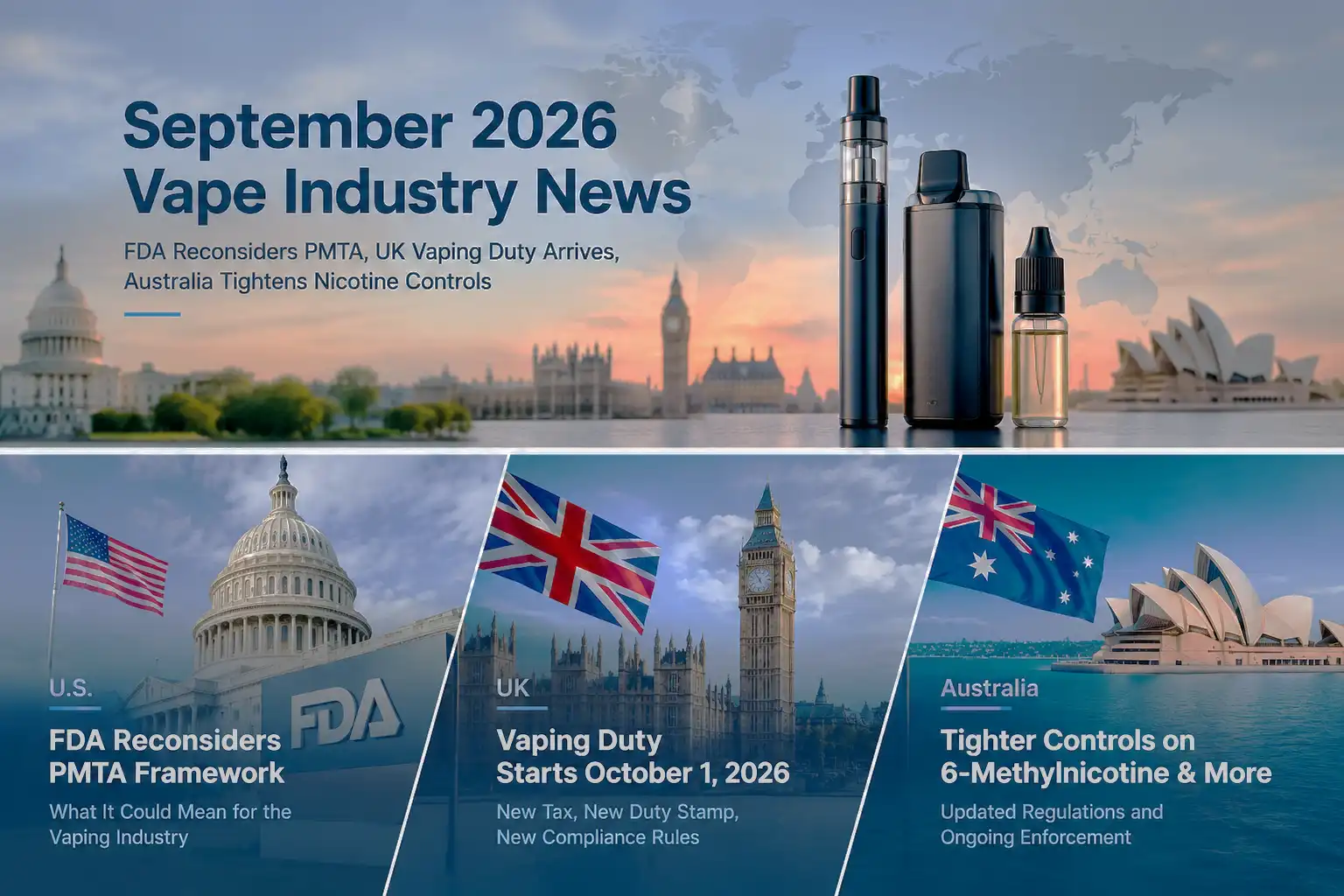
September 2026 has brought several important regulatory developments to the vaping industry across the United States, the United Kingdom, and Australia. From a potential rethink of the U.S. premarket review system to a new vaping duty in the UK and tighter controls on emerging nicotine substances in Australia, the latest changes show how quickly the regulatory environment is evolving.
For manufacturers, importers, distributors, and retailers, the developments are not limited to individual products. They also affect market entry, product registration, taxation, supply chains, and the way new nicotine products are introduced.
United States: FDA Signals a Possible New Direction for PMTA
One of the biggest U.S. vaping stories this September came from the U.S. Food and Drug Administration (FDA). On September 28, the agency announced that it intends to evaluate possible changes to the Premarket Tobacco Product Application (PMTA) regulatory framework.
Why is the PMTA framework being reconsidered?
The FDA said its review is based on its experience implementing the current framework, recent judicial developments, the widespread development of an illicit and unregulated market, and the rapid pace at which new products are being introduced.
The agency indicated that it may initiate new rulemaking to replace the existing framework. However, this does not mean that the current PMTA requirements have been suspended. The FDA stated that it will continue to process PMTA submissions, conduct premarket reviews, and issue regulatory decisions under the existing statutory requirements while any future changes are considered.
For businesses operating in the U.S. market, this creates an important distinction: the regulatory framework may change in the future, but existing requirements remain in effect today.
FDA also updates vaping and tobacco product registration
On September 29, the FDA announced a redesigned Form FDA 3741 for tobacco product establishment registration and product listing. The new form consolidates previously separate forms and now covers multiple regulated tobacco product categories, including e-cigarettes, heated tobacco products, and oral nicotine products.
The update is intended to simplify regulatory submissions and allow manufacturers to update specific information without resubmitting unchanged sections. The FDA is also encouraging electronic submissions through its Tobacco Registration and Product Listing Module Next Generation.
Together, these developments suggest that the U.S. regulatory system is entering a period of adjustment: the FDA is considering structural changes to PMTA while simultaneously modernizing some of the administrative processes used by the industry.
United Kingdom: Vaping Duty Takes Effect on October 1
For the UK vaping market, September is effectively the final preparation period before a major new tax regime begins. The UK government is introducing Vaping Products Duty (VPD) and a Vaping Duty Stamps Scheme from October 1, 2026.

What changes on October 1?
From October 1, Vaping Products Duty will be charged at a flat rate of £2.20 per 10ml of vaping liquid. The duty applies to vaping liquids regardless of whether they contain nicotine.
At the same time, vaping products released for the UK market will generally need to carry a vaping duty stamp. The new system is designed to help identify legitimate products intended for the UK market and support enforcement against illicit trade.
The transition will not happen overnight. Retailers can continue selling unstamped stock that was already held before October 1 until March 31, 2027. However, new duty-liable stock released onto the UK market from October 1 must comply with the new stamping requirements.
What does this mean for overseas manufacturers?
The changes are particularly relevant to overseas manufacturers and exporters. Businesses that want to arrange stamping outside the UK must work with an approved UK representative, while manufacturers, warehousekeepers, and other businesses involved in the duty system may need HMRC approval.
From January 1, 2027, only digital vaping duty stamps can be affixed to products. Businesses supplying the UK therefore need to consider not only the additional tax cost but also packaging, inventory, documentation, and supply-chain procedures.
For the UK market, October 1 is therefore more than a tax deadline. It marks the beginning of a new product-traceability and compliance system for vaping products.
Australia: New Controls on 6-Methylnicotine and Continued Vape Enforcement
Australia is also seeing significant regulatory activity this September. On September 25, the Therapeutic Goods Administration (TGA) published its final decision concerning 6-methylnicotine and amendments to the Poisons Standard.
6-Methylnicotine moves into a stricter regulatory category
The decision concerns 6-methylnicotine, an emerging nicotine-related substance that has attracted attention as manufacturers and consumers explore alternatives to conventional nicotine.
The final scheduling decision forms part of Australia’s national system for controlling how medicines and poisons are made available. The change is particularly relevant to companies developing or importing products containing newer nicotine-related substances, because the regulatory status of a substance can directly affect whether and how it may be supplied.
For manufacturers and distributors, the development highlights an important point: introducing a new nicotine analogue or alternative does not necessarily place it outside Australia’s regulatory framework.
TGA continues enforcement against unlawful vape supply
Australia is also continuing active enforcement against unlawful vape distribution. In September, the TGA announced that a New South Wales company had paid two infringement notices totaling A$39,600 following allegations of unlawful supply of vaping goods.
The TGA stated that general retailers, including tobacconists, convenience stores, and service stations, cannot sell vaping goods. Therapeutic vaping products for smoking cessation or nicotine dependence are supplied through participating pharmacies where clinically appropriate.

This follows a broader enforcement campaign. Earlier in August, coordinated operations involving the TGA and law enforcement agencies resulted in the seizure of approximately 245,473 unlawful vaping goods and 60,000 nicotine pouches in New South Wales.
The Australian market therefore continues to combine a tightly controlled therapeutic pathway with active enforcement against unauthorized retail supply.
What These September Developments Mean for the Global Vape Market
Regulation is becoming more product-specific
One common thread across these three markets is that regulators are increasingly looking beyond the broad category of “vaping.” Different product types, nicotine substances, manufacturing processes, and distribution channels can now trigger different requirements.
In the United States, the focus remains on premarket authorization and product listings. In the UK, taxation and product traceability are becoming increasingly important. In Australia, the legal pathway is closely connected to the therapeutic status and regulatory classification of the product.
Supply-chain compliance is becoming part of product strategy
For international manufacturers and distributors, compliance is no longer something that happens only after a product has been designed. Product composition, packaging, documentation, registration, taxation, and distribution channels increasingly need to be considered before entering a market.
This is particularly important for businesses selling across multiple regions. A product that can be legally supplied in one market may require a different notification, authorization, tax treatment, or distribution model in another.
September 2026 marks a period of transition
The latest developments do not point to a single global regulatory model. Instead, the United States, UK, and Australia are moving in different directions while placing greater emphasis on market control, product traceability, and regulatory compliance.
For the vaping industry, the coming months will be worth watching closely. The FDA’s potential PMTA reform, the UK’s new vaping duty system, and Australia’s evolving approach to nicotine-related substances could all influence how manufacturers and retailers plan their products and supply chains heading into 2027.