USA
USA Italy
Italy France
 UK
UK Germany
 Japan
Japan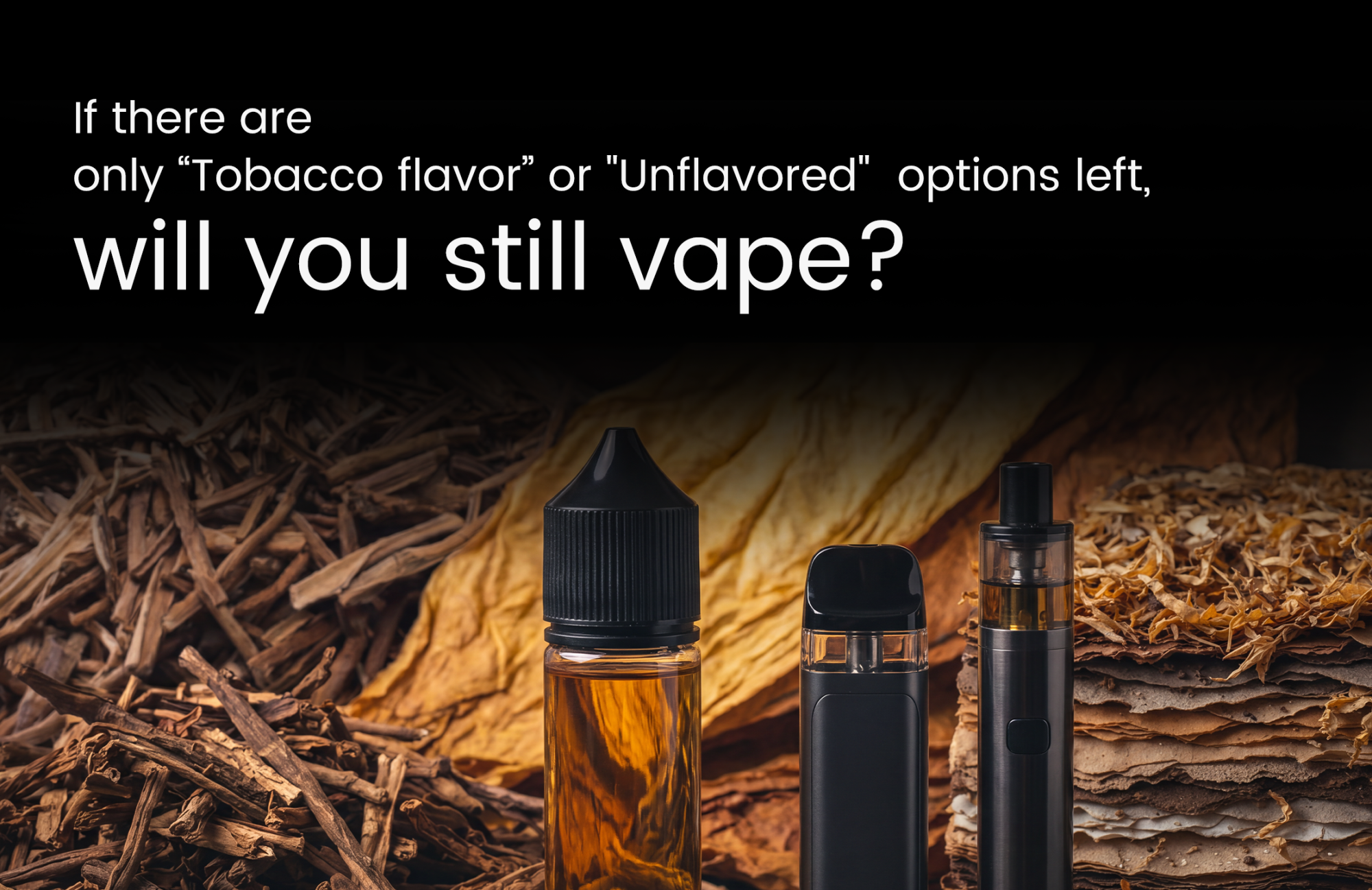
Imagine walking into a vape shop a few years from now and finding only two choices on the shelf: Tobacco or Unflavored. No blueberry, no mango, no mint, no icy blends, and no dessert flavors.
Would you keep vaping, switch to something else, or simply stop?
That question may sound hypothetical, but the data behind it is surprisingly interesting. In Great Britain, 60% of adult vapers chose fruit as their main vape flavor in 2026, compared with just 9% who chose tobacco. In the U.S., 89.4% of current youth e-cigarette users reported using flavored products in 2025, while overall youth e-cigarette use fell to 5.2%.
Among U.S. adults who smoke or formerly smoked, fruit was also the most commonly used vape flavor in 2022 at 33.9%, ahead of tobacco at 20.1%.
Together, these numbers raise an important question: what happens if the flavors people actually prefer disappear?
This statistics roundup brings together recent government data, national surveys, peer-reviewed studies and regulatory research to examine vape flavor preferences, Tobacco vape flavor, flavor restrictions and what consumers may do if their usual choices are no longer available.

Key Takeaways
- ▪ 60% of Great Britain’s adult vapers chose fruit as their main flavor in 2026, while only 9% chose tobacco.
- ▪ 43% of Great Britain vapers reported sometimes or always using “ice” flavors in 2026.
- ▪ 89.4% of U.S. youth who currently vaped used flavored e-cigarettes in 2025.
- ▪ 53.4% of U.S. youth e-cigarette users reported using a flavor containing “ice” or “iced” in its name in 2025.
- ▪ Among U.S. adults who smoked or formerly smoked and vaped in 2022, fruit was the most commonly used flavor at 33.9%, versus 20.1% for tobacco.
- ▪ In a 2021 U.S. study of adults vaping during a smoking-cessation attempt, 90.7% had used a flavor potentially affected by flavor restrictions.
- ▪ In a three-state U.S. study, 8.1% of regular adult vapers stopped vaping after flavor restrictions were introduced.
- ▪ After those restrictions, the share using non-flavored products increased from 5.4% to 25.4%.
- ▪ A 2024 systematic review found that the four studies examining flavor bans generally associated them with lower youth vaping, although the evidence had moderate-to-serious risk of bias.
- ▪ In Great Britain’s 2026 hypothetical flavor-ban question, 37% of vapers expected to reduce vaping, while 15% thought their smoking would increase.
1. Vape Flavor Preferences Are Far Broader Than Tobacco
Current surveys do not support treating tobacco as the default flavor preference among most vapers. In both the United States and Great Britain, fruit is substantially more common, although the exact percentages differ because the surveys measure different populations and use different questions.
According to the 2026 ASH survey, fruit was the main vape flavor for 60% of adult vapers in Great Britain, compared with 15% for menthol/mint and just 9% for tobacco.
| Metric | Value | Source |
|---|---|---|
| Fruit as main flavor, GB adult vapers | 60% | ASH 2026 |
| Menthol/mint | 15% | ASH 2026 |
| Tobacco | 9% | ASH 2026 |
| Sweet/soft/energy drink | 6% | ASH 2026 |
| Fruit preference among GB vapers aged 18–34 | 73% | ASH 2026 |
| Fruit preference among GB vapers aged 55+ | 41% | ASH 2026 |
| Fruit preference among never-smokers who vape | 56% | ASH 2026 |
| Fruit preference among current smokers who vape | 62% | ASH 2026 |
The historical change is also notable. In the same GB survey series, tobacco was the leading flavor in 2016 at 33%, while fruit was selected by 22%. By 2026, tobacco had fallen to 9% while fruit had risen to 60%.
This does not mean every vaper rejects Tobacco vape flavor. It means that eliminating non-tobacco choices would remove the category currently preferred by a large share of consumers.
2. U.S. Data Shows the Same Preference Gap
The U.S. evidence points in a similar direction, particularly among adults with a history of cigarette smoking.
Among U.S. adults who smoked or formerly smoked and vaped at least monthly, fruit was the most commonly used flavor in 2022 at 33.9%, while tobacco accounted for 20.1%.
| Metric | Value | Source |
|---|---|---|
| Fruit | 33.9% | ITC Four Country Survey |
| Tobacco | 20.1% | ITC Four Country Survey |
| Menthol | 12.2% | ITC Four Country Survey |
| Candy/sweets | 10.8% | ITC Four Country Survey |
| Mixed ice | 10.0% | ITC Four Country Survey |
| Adults smoking/formerly smoking who vaped monthly | 22.0% | ITC Four Country Survey |
The study surveyed 2,016 U.S. adults who smoked or formerly smoked, with 554 current monthly vapers included in the flavor analysis.
Another large U.S. online study involving 69,233 adult vapers found that 83.0% reported fruit among flavors used regularly, compared with 7.8% for tobacco and 1.0% for unflavored products. Because participants could select multiple flavors, these figures should not be interpreted as mutually exclusive market shares.
3. What Would Happen Under a Tobacco-or-Unflavored-Only Scenario?
The most directly relevant evidence comes from surveys that asked vapers what they would actually do under hypothetical flavor restrictions.
In the 2026 ASH Great Britain survey, 37% of current vapers said a restriction limiting flavors to tobacco, menthol and mint would reduce their vaping, while 52% said it would not change their vaping behavior.
| Hypothetical Response | Value | Source |
|---|---|---|
| No change in vaping | 52% | ASH 2026 |
| Reduce vaping | 37% | ASH 2026 |
| Increase vaping | 3% | ASH 2026 |
| Don’t know | 9% | ASH 2026 |
| Expect smoking to increase | 15% | ASH 2026 |
| Expect smoking to decrease | 4% | ASH 2026 |
| Expect smoking to stop | 2% | ASH 2026 |
| Would use legally available flavors if continuing | 65% | ASH 2026 |
| Would stockpile other flavors | 30% | ASH 2026 |
| Would access illegal flavors | 14% | ASH 2026 |
| Would make their own liquids | 7% | ASH 2026 |
| Would use unflavored vapes | 7% | ASH 2026 |
This is particularly useful for the question “If there are only Tobacco or Unflavored options left, will you still vape?” The survey suggests that a majority would not necessarily stop vaping, but only a small minority specifically expected to switch to unflavored products.
The distinction matters: continuing to vape is not the same as accepting unflavored or Tobacco vape flavor as an equivalent substitute.
4. Real-World Flavor Restrictions Change Consumer Behavior
Hypothetical surveys are useful, but observed behavior after regulations provides another layer of evidence.
A study of 1,624 adults who vaped at least weekly before flavor bans in Washington, New Jersey and New York found that 8.1% stopped vaping after the restrictions.
| Behavior Before vs. After Restrictions | Before | After |
|---|---|---|
| Banned menthol/other flavors | 74.4% | 50.8% |
| Tobacco flavor | 20.1% | 15.6% |
| Non-flavored products | 5.4% | 25.4% |
| Stopped vaping | — | 8.1% |
The largest shift was toward non-flavored products: their reported use increased from 5.4% to 25.4%. This is a calculated increase of 20.0 percentage points, based directly on the study’s reported before-and-after figures.
However, this should not be interpreted as proof that all flavor bans produce the same result. The study covered three states, and regulatory implementation, enforcement and product availability can differ considerably.
5. The Smoking-Cessation Question Is More Complicated
Flavor restrictions are partly justified by evidence concerning youth appeal, but researchers also study how restrictions affect adults who vape while trying to stop smoking.
A 2021 U.S. study published through PubMed surveyed 857 adults who used e-cigarettes during a recent attempt to quit smoking.
Among these adults, 30.2% reported restricted access to flavors they liked. Among those respondents, 39.4% switched devices to continue using preferred flavors, 35.9% used the same device with available flavors, and 19.3% obtained preferred flavors elsewhere.
Among these adults, 90.7% reported using a flavor that could potentially be affected by restrictions, compared with 64.9% who used tobacco or menthol flavors.
The study found no statistically significant association between experiencing flavor restrictions and successfully quitting smoking for at least one month.
That result should not be interpreted as evidence that flavor restrictions are harmless or ineffective overall; the study population consisted specifically of adults using e-cigarettes during smoking-cessation attempts.
A separate quasi-experimental analysis using 242,154 U.S. adults aged 18–29 found that state ENDS flavor restrictions were associated with reductions in daily vaping but increases in daily cigarette smoking. This is an association from an observational policy analysis, not proof that flavor restrictions directly caused the smoking increase.
6. Why Flavor Restrictions Remain a Major Policy Issue
The strongest case for restrictions comes from youth data.
According to the FDA’s 2025 National Youth Tobacco Survey results, 5.2% of middle and high school students reported current e-cigarette use, representing approximately 1.44 million students.
| Youth Vaping Metric | Value | Source |
|---|---|---|
| Current e-cigarette use, all students | 5.2% | FDA/NYTS 2025 |
| Current use, high school | 7.1% | FDA/NYTS 2025 |
| Current use, middle school | 2.6% | FDA/NYTS 2025 |
| Daily use among youth vapers | 27.5% | FDA/NYTS 2025 |
| Use on ≥20 of past 30 days | 41.2% | FDA/NYTS 2025 |
| Flavored e-cigarette use | 89.4% | FDA/NYTS 2025 |
| “Ice/iced” flavor use | 53.4% | FDA/NYTS 2025 |
| Disposable use | 66.3% | FDA/NYTS 2025 |
The trend is not simply that youth vaping is rising. FDA reports that youth e-cigarette use declined during 2022–2025. The important finding for the flavor debate is that flavored products remain overwhelmingly common among those who still vape.
A 2024 systematic review of 30 studies found that the four studies examining flavor bans generally associated them with reduced youth vaping, although the review also rated the evidence as having moderate-to-serious risks of bias.
7. The Regulatory Direction Is Moving Toward Flavor Restrictions
Flavor regulation is no longer limited to individual U.S. jurisdictions.
The World Health Organization reported in May 2025 that more than 50 countries banned flavored tobacco products, while seven countries specifically banned e-cigarette flavors. WHO also called for governments to prohibit flavors in tobacco and nicotine products.
In the United States, FDA’s regulatory framework also increasingly focuses on flavored ENDS. In 2023, FDA issued marketing denial orders covering approximately 6,500 flavored e-liquid and e-cigarette products from 10 companies. In 2026, FDA’s guidance list includes a draft document specifically addressing flavored ENDS premarket applications and youth risk considerations.
At the same time, FDA has authorized selected tobacco and menthol products. In July 2025, for example, FDA authorized five JUUL products, including Virginia Tobacco and Menthol JUULpods.
This creates an important distinction: a future market with only authorized tobacco or unflavored products is a plausible regulatory scenario, but current U.S. policy is not equivalent to a universal tobacco-and-unflavored-only rule.
Flavor Ban by the Numbers
| Metric | Value | Source |
|---|---|---|
| GB vapers choosing fruit | 60% | ASH 2026 |
| GB vapers choosing menthol/mint | 15% | ASH 2026 |
| GB vapers choosing tobacco | 9% | ASH 2026 |
| GB vapers using ice flavors | 43% | ASH 2026 |
| GB vapers aged 18–34 choosing fruit | 73% | ASH 2026 |
| U.S. youth current e-cigarette use | 5.2% | FDA/NYTS 2025 |
| U.S. youth current e-cigarette users | 1.44 million | FDA/NYTS 2025 |
| U.S. youth vapers using flavors | 89.4% | FDA/NYTS 2025 |
| U.S. youth vapers using ice/iced flavors | 53.4% | FDA/NYTS 2025 |
| U.S. youth vapers using disposables | 66.3% | FDA/NYTS 2025 |
| U.S. adult vapers who smoked/formerly smoked using fruit | 33.9% | ITC 2022 |
| Same population using tobacco | 20.1% | ITC 2022 |
| Same population using menthol | 12.2% | ITC 2022 |
| Same population using candy/sweets | 10.8% | ITC 2022 |
| Same population using mixed ice | 10.0% | ITC 2022 |
| U.S. adults who smoked/formerly smoked vaping monthly | 22.0% | ITC 2022 |
| Adults affected by flavor restrictions in cessation study | 30.2% | Yale study |
| Those using potentially restricted flavors | 90.7% | Yale study |
| Those switching devices after restrictions | 39.4% | Yale study |
| Those obtaining flavors elsewhere | 19.3% | Yale study |
| Adults quitting vaping after three-state bans | 8.1% | U.S. three-state study |
| Non-flavored use before restrictions | 5.4% | U.S. three-state study |
| Non-flavored use after restrictions | 25.4% | U.S. three-state study |
| GB vapers expecting reduced vaping under hypothetical ban | 37% | ASH 2026 |
| GB vapers expecting no vaping change | 52% | ASH 2026 |
| GB vapers expecting increased smoking | 15% | ASH 2026 |
| GB vapers intending to use unflavored products | 7% | ASH 2026 |
What the Data Says About a Tobacco Vape Flavor-Only Future
The available evidence does not support a simple “everyone will quit” or “everyone will keep vaping” conclusion.
The strongest recent consumer data points toward a large preference gap between conventional tobacco flavor and fruit, menthol/mint, ice and other non-tobacco categories. In Great Britain, only 9% of adult vapers selected tobacco as their main flavor in 2026, while 60% selected fruit. U.S. research likewise finds fruit ahead of tobacco among adults who smoke or formerly smoked.
At the same time, real-world restrictions show that consumers respond in several different ways: some stop vaping, some switch to unflavored products, some continue with permitted flavors, and some seek restricted products elsewhere.
The most defensible conclusion is therefore narrower: if future regulations leave only tobacco or unflavored vape options, a substantial behavioral shift is likely, but the direction and size of that shift will depend on the available legal alternatives, enforcement, consumer smoking status and local market conditions.
Conclusion: Would Vapers Really Keep Vaping Without Flavors?
So, if the vape shelf of the future really offered only Tobacco or Unflavored, would people still vape?
The data suggests that there is no single answer. Some vapers would probably keep vaping, but many would change their behavior in one way or another. Some may reduce how often they vape, some may switch to unflavored products, and others may simply stop. The important point is that flavor restrictions would not affect every vaper in the same way.
What is much clearer is that tobacco flavor does not represent the preference of most current adult vapers. In Great Britain, fruit was the main flavor for 60% of adult vapers in 2026, compared with only 9% for tobacco. U.S. research shows a similar pattern, with fruit also ranking ahead of tobacco among adults who smoke or formerly smoked.
Citation Magnets
- 60% vs. 9%: Fruit was the main vape flavor for 60% of adult vapers in Great Britain in 2026, compared with 9% for tobacco.
- 89.4%: Nearly nine in ten U.S. youth who currently vape used flavored e-cigarettes in 2025.
- 5.4% → 25.4%: Non-flavored product use increased from 5.4% to 25.4% after flavor restrictions in a three-state U.S. adult study.
- 7%: Only 7% of GB vapers said they would use unflavored products under a hypothetical restriction limiting available flavors.
- 15%: In the same survey, 15% believed such restrictions would increase their smoking, compared with 4% who expected smoking to decrease.
External Sources
- FDA — 2025 National Youth Tobacco Survey Results
- ASH — Use of Vapes and Other Novel Tobacco and Nicotine Products Among Adults in Great Britain 2026
- International Tobacco Control Four Country Smoking and Vaping Survey study
- Peer-reviewed study of flavor restrictions in Washington, New Jersey and New York
- Peer-reviewed study of flavor restrictions among adults attempting to quit smoking
- American Journal of Preventive Medicine systematic review of vaping regulations
- World Health Organization — Flavored Tobacco and Nicotine Products
Related Resources
For readers looking for practical information beyond the statistics, related resources on MYVAPOR can include the Vape Flavor Guide, OVVIO Pod flavor and product information, and iSOLO AIR 2 flavor and airflow information. The MYVAPOR product collection also provides an overview of currently available vape categories and products for adult consumers.
Important: All statistics, figures, research findings and other data presented in this article are provided for general informational and reference purposes only. Please refer to the original linked sources and publications for the most accurate, complete and up-to-date information. In the event of any discrepancy, the original source or publication shall prevail. MYVAPOR does not provide, verify, or represent the information presented here as medical, scientific, clinical, or professional research advice. This article is not intended to provide medical advice, scientific conclusions, or recommendations regarding vaping, smoking, nicotine use, or related products. The information and statistics presented in this article are provided for reference only and should not be interpreted as medical or scientific guidance. Readers should consult the original research, official government sources, or qualified professionals when making decisions based on the information discussed.